Atlas · flora and fungi

Plants and mushrooms of Fruška Gora: edible and poisonous mushrooms, trees and flowers

About 1,500 plant species and more than 2,000 kinds of larger fungi grow on Fruška Gora. The trees and flowers around Rakovac, the mushrooms people pick here, and the deadly ones to know before you pick anything.
Line drawings of plants and mushrooms of Fruška Gora on a green background: linden and oak leaves, a flower, an edible mushroom and a death cap
Photo: rakovac.rs, illustration, © rakovac.rs

Forests cover about 90 per cent of the National Park: cool mixed woods of sessile oak and hornbeam, beech on the shaded slopes, warm forests of Turkey and Hungarian oak, and a large share of silver linden. On the sunny edges grow the remains of the old Pannonian steppe. The figure of more than 2,000 larger fungi comes from Eleonora Čapelja, president of the Novi Sad Mushroom Society (Telegraf).

Trees

Silver linden

Tilia tomentosa

The tree that gives the forests of Fruška Gora their character: silvery-white undersides to the leaves and fragrant blossom in early summer.

Sessile oak

Quercus petraea

With hornbeam it forms the cooler mixed forests on the slopes.

Turkey oak

Quercus cerris

An oak of the warm, dry slopes; its acorn cups are covered in long, curly scales.

Hungarian oak

Quercus frainetto

An oak with large, deeply lobed leaves that grows with the Turkey oak in the warm forests.

European beech

Fagus sylvatica

Grows on the cooler, shaded slopes; smooth grey bark and a deep, dark shade in summer.

Hornbeam

Carpinus betulus

A smooth, fluted grey trunk, as if made of muscle; a common companion of the sessile oak.

Flowers of the steppe slopes

Burning bush

Dictamnus albus

caution

A tall, fragrant plant of the sunny steppe slopes with pink-veined flowers. Do not touch it on sunny days: its oils, together with sunlight, can cause burn-like blisters on the skin.

Spring pheasant's eye

Adonis vernalis

poisonous

Large yellow flowers on the steppe slopes in early spring, a relic of the ancient steppe. Poisonous to people and animals; leave it where it grows.

Dwarf iris

Iris pumila

A tiny iris of the dry grassland, flowering in spring in violet or yellow; part of the relict steppe vegetation.

Feather grass

Stipa pulcherrima

The silky, feather-like awns of this steppe grass wave in the wind on the sunny slopes in early summer.

Orchids

Orchidaceae

protected

Orchids are among the plant families with the most species in the National Park. Admire and photograph them, but never pick or dig them up.

Mushrooms: read this first

Never eat a mushroom you are not completely sure of

Edible and poisonous mushrooms can look alike, and there is no rule of thumb that tells them apart: no silver spoon, no peeling test, no “the snails ate it”. Have every mushroom checked by an experienced picker or by the Novi Sad Mushroom Society (Gljivarsko društvo Novi Sad). The drawings on this page are decorative and must not be used for identification.

Mushrooms people pick (only after an expert’s check)

Morel

Morchella

One of the first mushrooms of the year, appearing soon after the snow melts. Lookalike: the poisonous false morel (Gyromitra), with a brain-like cap.

Chicken of the woods

Laetiporus sulphureus

Bright yellow-orange shelves on tree trunks, from May onwards.

Chanterelle

Cantharellus cibarius

Egg-yellow, with forked ridges instead of true gills, growing from the ground. Lookalike: the poisonous jack-o’-lantern (see below).

Beefsteak fungus

Fistulina hepatica

A liver-red bracket on old oaks that oozes red juice when cut.

Parasol mushroom

Macrolepiota procera

A tall mushroom with a snakeskin-patterned stem and a ring that slides up and down. Smaller, poisonous parasols look similar.

Porcini (cep)

Boletus edulis

Brown cap, pale pores instead of gills and a thick stem. It grows on Fruška Gora too, but in smaller numbers.

Poisonous and deadly

Death cap

Amanita phalloides

deadly poisonous

Responsible for most fatal mushroom poisonings worldwide. Greenish-olive cap, white gills, a ring on the stem and a sack-like volva at the base. A single cap can kill, and symptoms start only after about 12 hours.

Destroying angels

Amanita verna, A. virosa

deadly poisonous

All-white relatives of the death cap and just as deadly. Easily mistaken for young white field mushrooms: check for the volva at the base.

Jack-o'-lantern

Omphalotus olearius

poisonous

Orange like a chanterelle, but grows in clusters on wood and has true, crowded gills. Causes vomiting and diarrhoea.

Fly agaric

Amanita muscaria

poisonous

The fairy-tale red mushroom with white spots. Poisonous: never eat it.

If someone may be poisoned

  • Go to hospital at once, or call 194. Do not wait for symptoms to pass and do not treat yourself.
  • With the death cap, symptoms start only about 12 hours after the meal; treatment within the first 48 hours greatly improves the chances (Military Medical Academy, quoted by BBC News Serbian).

Sources

More in Nature

Old quarry · also called Rakovac Cave

Beli Majdan

A quarried hall in the hillside above the monastery, its roof held up by pillars of stone the quarrymen left standing. Ten minutes on foot from the monastery.

about 600 m from the monastery10 minutes one way Good for kids

Isposnica · 18th-century rock hermitage

Hermitage of Isaija Parivodski

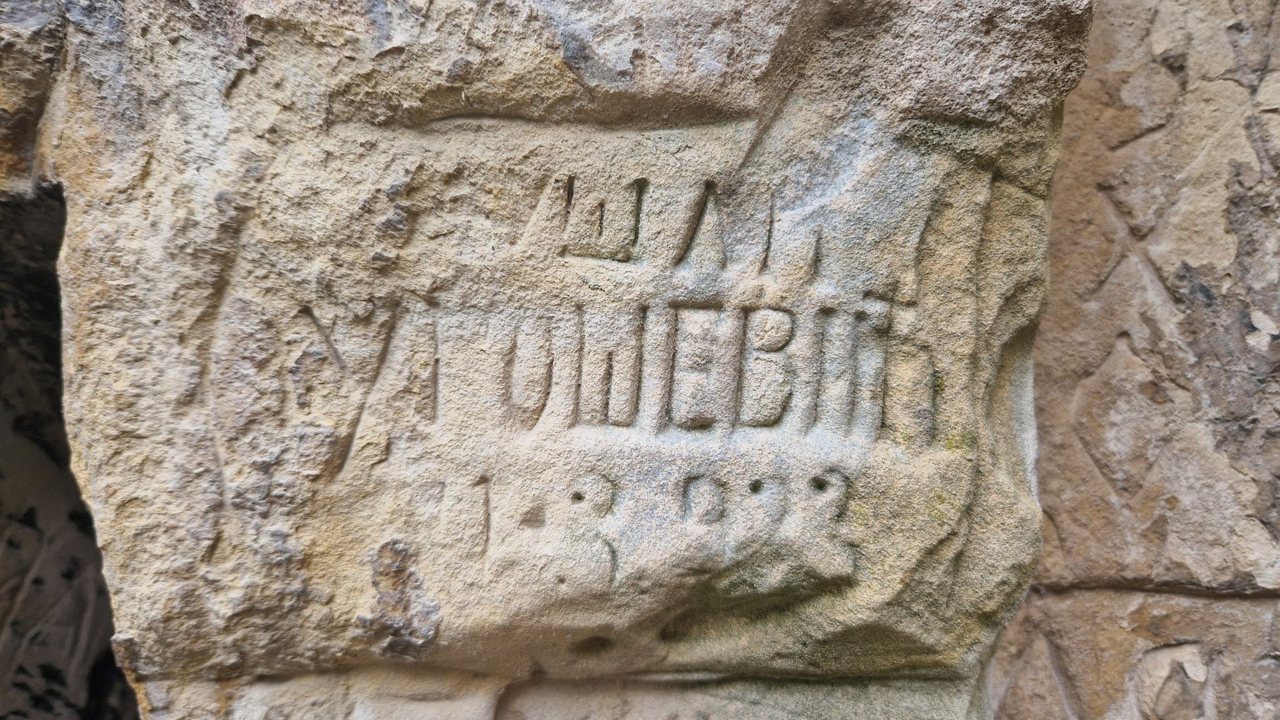
A tiny monk’s cell cut into a limestone cliff deep in the forest, named after Isaija Parivodić, a hieromonk of Rakovac who carved his name here in 1771. The only rock hermitage in Vojvodina.

about 40 minutes' walk from Beli Majdanabout 1 hour from the monastery

Dumbovački vodopad

Dumbovac Waterfall

A five-metre waterfall hidden in dense forest on the Dumbovac stream. About an hour’s walk from the monastery.

about 3 km one way from the monasteryabout 1 hour one way