 Rakovac
Old quarry · also called Rakovac Cave
Beli Majdan
A quarried hall in the hillside above the monastery, its roof held up by pillars of stone the quarrymen left standing. Ten minutes on foot from the monastery.
Isposnica · 18th-century rock hermitage
A low doorway and one small window cut into pale limestone, in forest so thick that the place has survived almost untouched. Monks from Rakovac Monastery came here to live in solitude and prayer.
An isposnica is a hermitage: a place where a monk withdrew from the monastery to live alone, fast and pray. This one is carved into soft, light limestone on a small plateau below a cliff. The entrance is set slightly to the side and is less than 1.5 m high. A narrow window lets in a little light.
It is the only hermitage of its kind in Vojvodina. Tourist guides often call it a protected cultural monument, but we have not found it in the official register, and one detailed account says it is not protected. It is believed to have been made by monks of Rakovac Monastery in the 18th century.
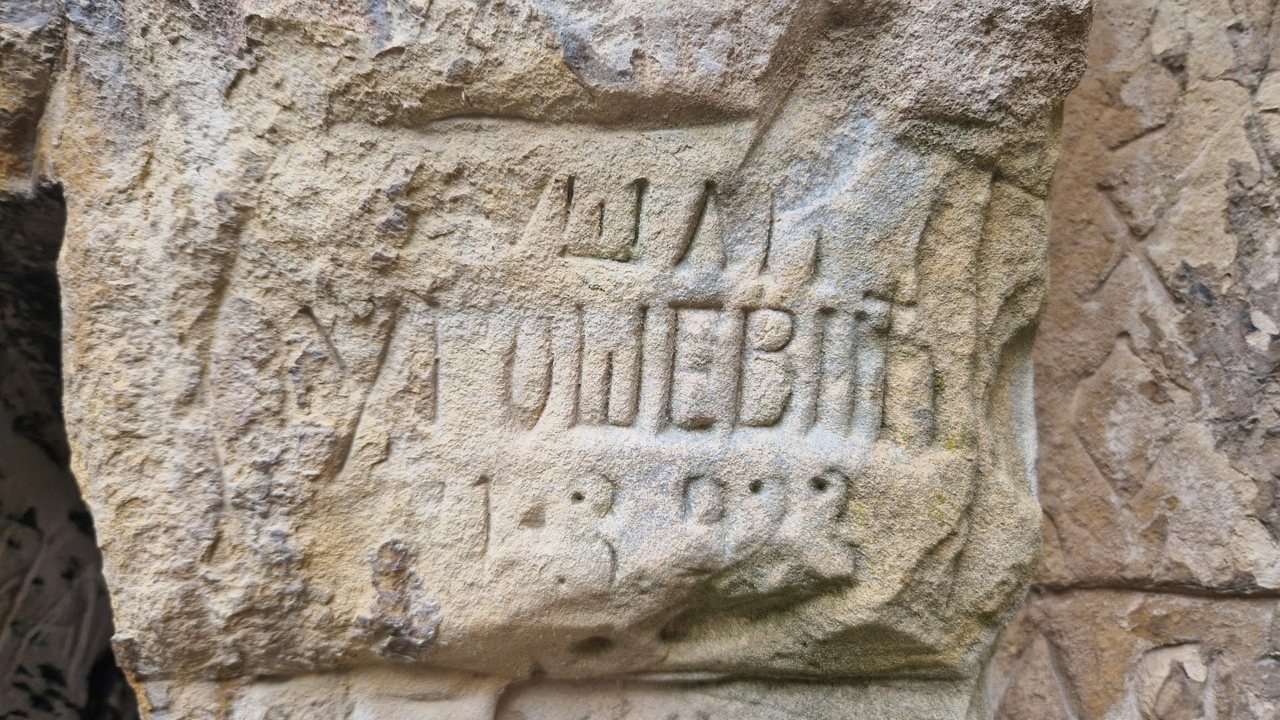
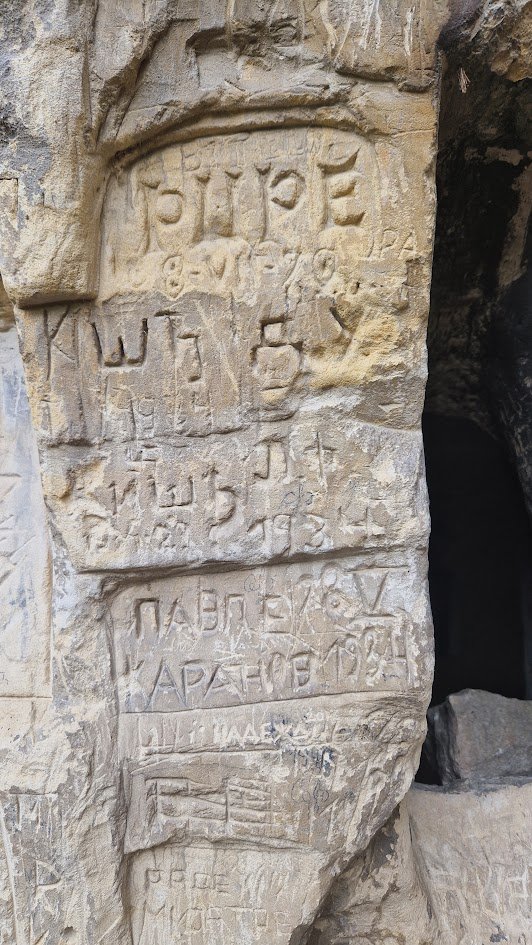
The rock around the entrance is covered with names and dates carved over more than two centuries, many in old church script, alongside plenty of modern signatures.
Published descriptions agree that the oldest dated inscription belongs to the man the hermitage is named after: Isaija Parivodić, hieromonk of Rakovac, who carved it in 1771 and wrote that he stayed at the cave “at the time of his infirmity”. He is considered the first monk of Rakovac to live here. One tourist guide gives the year as 1711; the other descriptions read 1771. He signed himself Parivodić; guides and signposts call him Parivodski.
This is how the text reads on one of our photographs (the end of the surname is hard to make out):
При пещрѣ сей во времѧ
немощи своеа въ мцъ
маій 1771го года преби-
валъ Исаіа Париводи…
іеромонахъ раковачкій
“At this cave, at the time of his infirmity, in the month of May 1771, stayed Isaija Parivod…, hieromonk of Rakovac.”
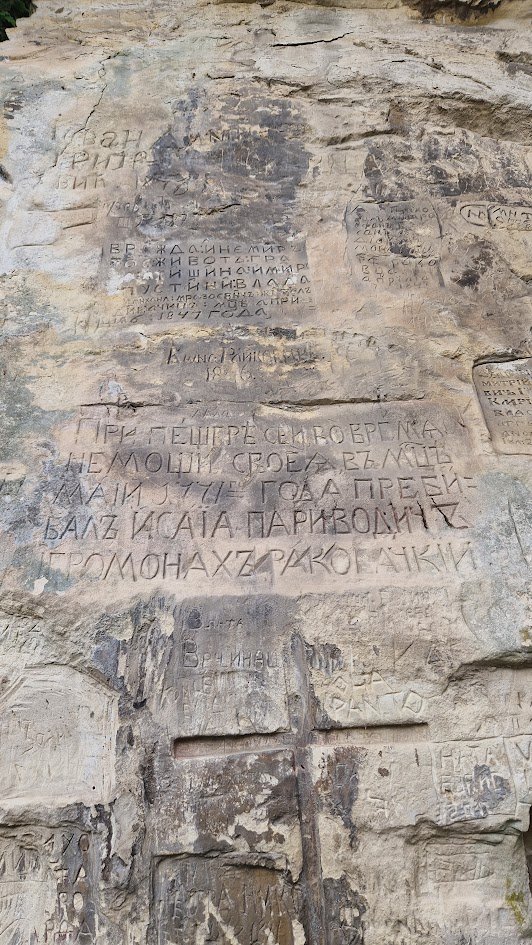
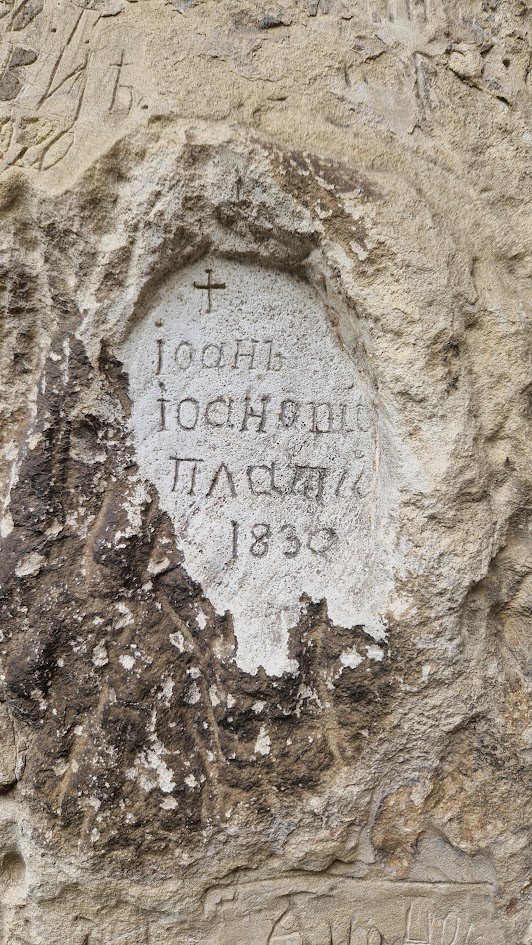
Around it, visitors kept adding their own marks: a name of 1830 in its own niche under a carved cross, what appears to be a verse dated 1847, contrasting the strife of the town with the peace of the wilderness, and names from the 19th and 20th centuries right up to our time.
Isaija was a monk and scribe. In 1767 he made the copy of Abbot Teofan’s monastery chronicle that preserves the founding legend of Rakovac. The Eparchy of Srem also names him as a copyist of a Srbljak, the book of church services to Serbian saints, and writes that he rests at the hermitage, near the former monks’ cemetery, which was nationalised after the Second World War. More in Isaija Parivodski.
Wear proper shoes, and in summer protect yourself against mosquitoes. Camping and fires are not allowed.
Old quarry · also called Rakovac Cave
A quarried hall in the hillside above the monastery, its roof held up by pillars of stone the quarrymen left standing. Ten minutes on foot from the monastery.
Dumbovački vodopad
A five-metre waterfall hidden in dense forest on the Dumbovac stream. About an hour’s walk from the monastery.
Vidikovac Kesten
A viewpoint above the village with a wide view over Novi Sad and the Danube plain.

