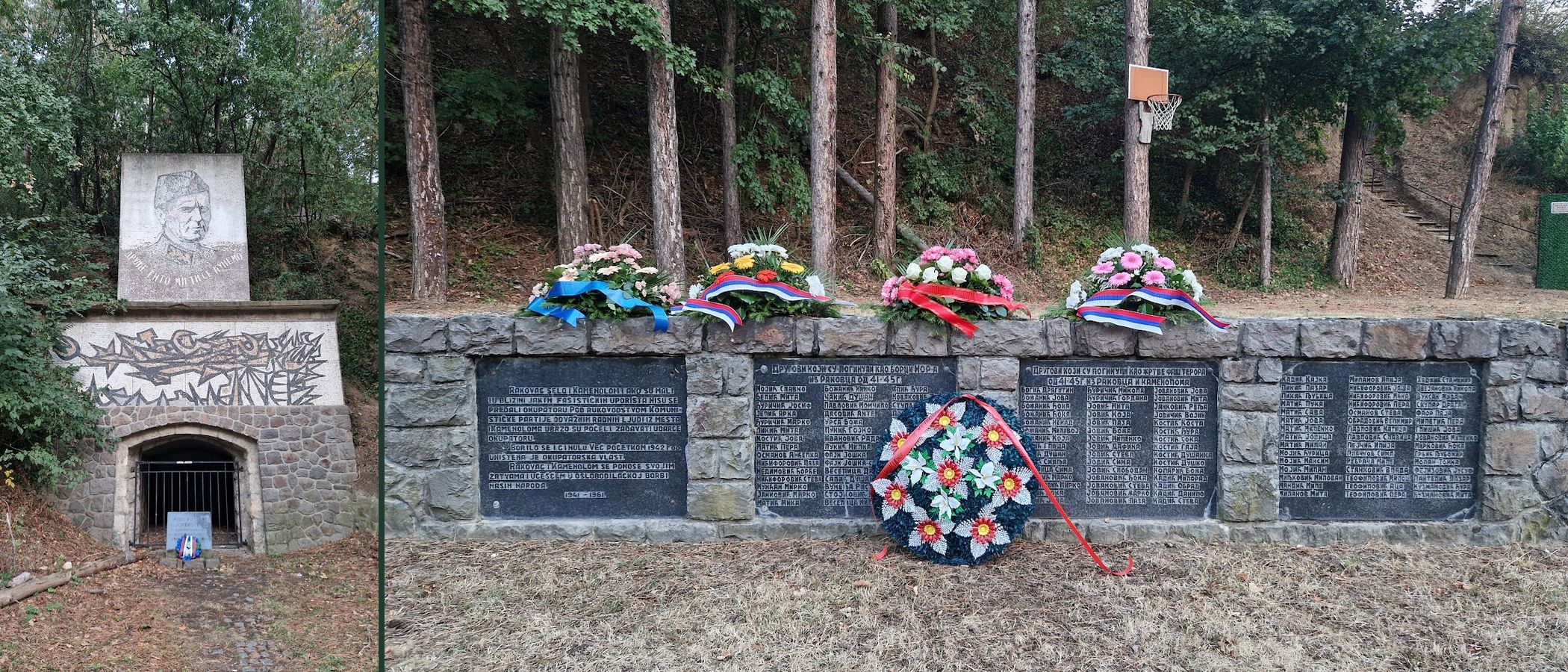
From April 1941 the whole of Srem, Rakovac included, was placed under the Independent State of Croatia (NDH). In September 1941 residents of Rakovac and workers of the stone quarry, organised in two small combat groups, took the partisan oath at the place now marked by the Kamenolom memorial.
The quarry as an arsenal
The quarry above Rakovac became a supply source for the Fruška Gora partisans:
13 May 1942: a partisan company stopped work at the quarry and took 8 rifles and 550 rounds of ammunition.
4 June 1942: they seized 225 kg of dynamite, thousands of detonators and an electric firing device.
10 July 1942: they blew up a bridge on the Rakovac–Beočin road and a power pylon that supplied the quarry and the Beočin cement factory.
The August offensive of 1942
At the end of August 1942 German, Croatian and Hungarian forces, around 17,000–18,000 men according to different accounts, surrounded Fruška Gora. About 410 partisans were inside the ring. During the breakout the staff of the Srem detachments was caught at Stručica in Rakovac. Commander Đorđe Marković Đilas, commissar Stanko Paunović Veljko and the courier Zencel Hunjadi, known as “Franja”, were killed there. The Stručica memorial marks the spot. Rakovac commemorates the offensive every year on 25 August.
1943
In 1943 a partisan printing press was discovered in Rakovac Monastery. The monastery was looted and its church and bell tower were blown up. The old village was burned and many of its people were killed. In total 91 civilians from Rakovac died during the occupation.
After the war the old village was not rebuilt. A new settlement, Novi Rakovac, grew further down the valley.
Sources and open questions
Dates and numbers come from the published chronology of the liberation war (1963), Serbian Wikipedia and the inscriptions on the memorials. The memorial boards and the chronology give different dates for the deaths at Stručica (27/28 August or 31 August 1942). The courier’s first name also appears in two forms, Zencel and Vencel.
Editor's note: Local journalism: record interviews with the oldest residents about 1943 and the rebuilding. The Archive of Vojvodina holds the Rakovac quarry records 1929–1955 (fond F.128), open to the public.
Seven thousand years in one place: a Neolithic village, a Roman villa, a medieval Benedictine abbey that became a fortress, and today an excavation site on the edge of Rakovac.
The memorial near the monastery where villagers and quarry workers took the partisan oath in 1941, with the names of the fallen and of the civilian victims.
 Rakovac