A legend written down in 1704 tells how Raka Milošević, chief chamberlain of Despot Jovan Branković, killed a deer at this spot at the end of the 15th century. The deer was a symbol of monastic purity, and Raka vowed to atone by building a church where it fell. Tradition gives the year as 1498, and the monastery and the village took their name from him.
The first records
History proper begins with the Ottoman tax registers of 1545–1546, which list the monastery and the tax it paid. Fragments of frescoes from the first half of the 16th century survive inside the church. During the 17th century the monastery was damaged and abandoned several times and rebuilt each time.
A monastery of scribes
In the early 18th century Rakovac ran an active scriptorium. Here, in 1700, the hieromonk Pahomije made a new copy of Dušan’s Code, the law code of the medieval Serbian state. In 1714 the monk Maksim finished the Rakovac Srbljak, a liturgical book collecting the hymns to Serbian ruler-saints, edited by Abbot Teofan.
The baroque golden age
The 18th century was the monastery’s best period. Metropolitan Vićentije Jovanović paid for the tall baroque bell tower (1735). Vasa Ostojić painted the icons of the iconostasis (1763), Amvrosije Janković painted the refectory (1768), and the residential wings took their final three-sided form in 1771. So many future bishops took their vows or lived here that Rakovac was nicknamed the “court monastery”. See People.
War and destruction
The monastery was looted in the First World War. In the Second World War, after a partisan printing press was discovered inside, the church and bell tower were mined and blown up in 1943, and valuables were taken to Zagreb. The old village around it was burned.
Rebirth
The church was largely rebuilt in the 1990s, and work on the residential buildings began in 2003 with the help of donations. The monastery was declared a Monument of Culture of Exceptional Importance in 1990. From 1990 to 2020 it was led by Hegumeness Gavrila Bedov.
Seven thousand years in one place: a Neolithic village, a Roman villa, a medieval Benedictine abbey that became a fortress, and today an excavation site on the edge of Rakovac.
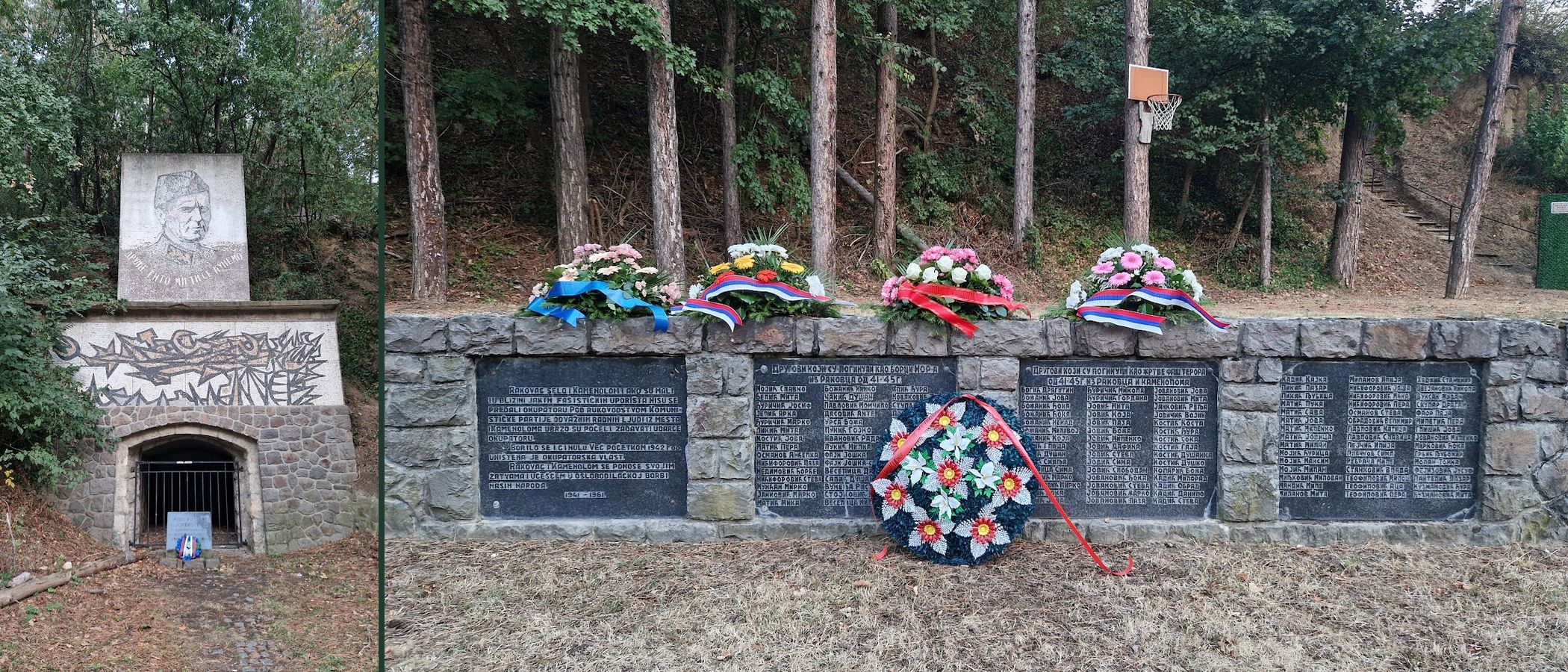
The memorial near the monastery where villagers and quarry workers took the partisan oath in 1941, with the names of the fallen and of the civilian victims.
 Rakovac