Rakovac
From a legend of 1498 to today
The story of Rakovac Monastery
A hunter’s vow, a scriptorium that copied Serbia’s medieval law code, a baroque golden age, destruction in 1943 and a slow rebirth.
Archaeological site · protected cultural property
 TEMP PHOTO
In Novi Rakovac, the lower part of the village, lies Gradina, one of the most important archaeological sites on Fruška Gora. People have lived here, on and off, for about seven thousand years.
In the 12th century the abbey built a Romanesque three-aisled basilica about 32 m long, with three semicircular apses and a crypt. Inside stood a richly carved marble chancel screen decorated with palmettes, braided bands, animal medallions and peacocks. Historians disagree on the date: some place the basilica in the early 12th century under King Coloman, others give the founding as 1176–86.
The abbey is first named in a charter of 1237 (“Abbas de Dombo”). A document of 1390 calls it the monastery of St George of Dombó in the diocese of Kalocsa. In 1416 its abbot, George, was taken prisoner by Ottoman raiders.
Between 1467 and 1473 the abbey was converted into a fortress with walls, gates and a moat, and a Gothic church was built. In 1473 a charter complains of the “castellans of Dombó” using force against a neighbouring estate. During the Ottoman campaign of 1526, the one that ended at Mohács, Dombó fell. When and how the ruins finally disappeared is still debated: sources name 1702, others 1792.
The Museum of Vojvodina excavated Gradina systematically between 1963 and 1978, and work has resumed several times since. Finds from Rakovac, including a hoard of twelve Byzantine bronze icons and carved stone, are on display at the Museum of Vojvodina in Novi Sad (Dunavska 35).
From a legend of 1498 to today
A hunter’s vow, a scriptorium that copied Serbia’s medieval law code, a baroque golden age, destruction in 1943 and a slow rebirth.
1941–1945
Quarry workers who swore the partisan oath, raids on the quarry’s dynamite store, the great offensive of August 1942, and a village burned in 1943.
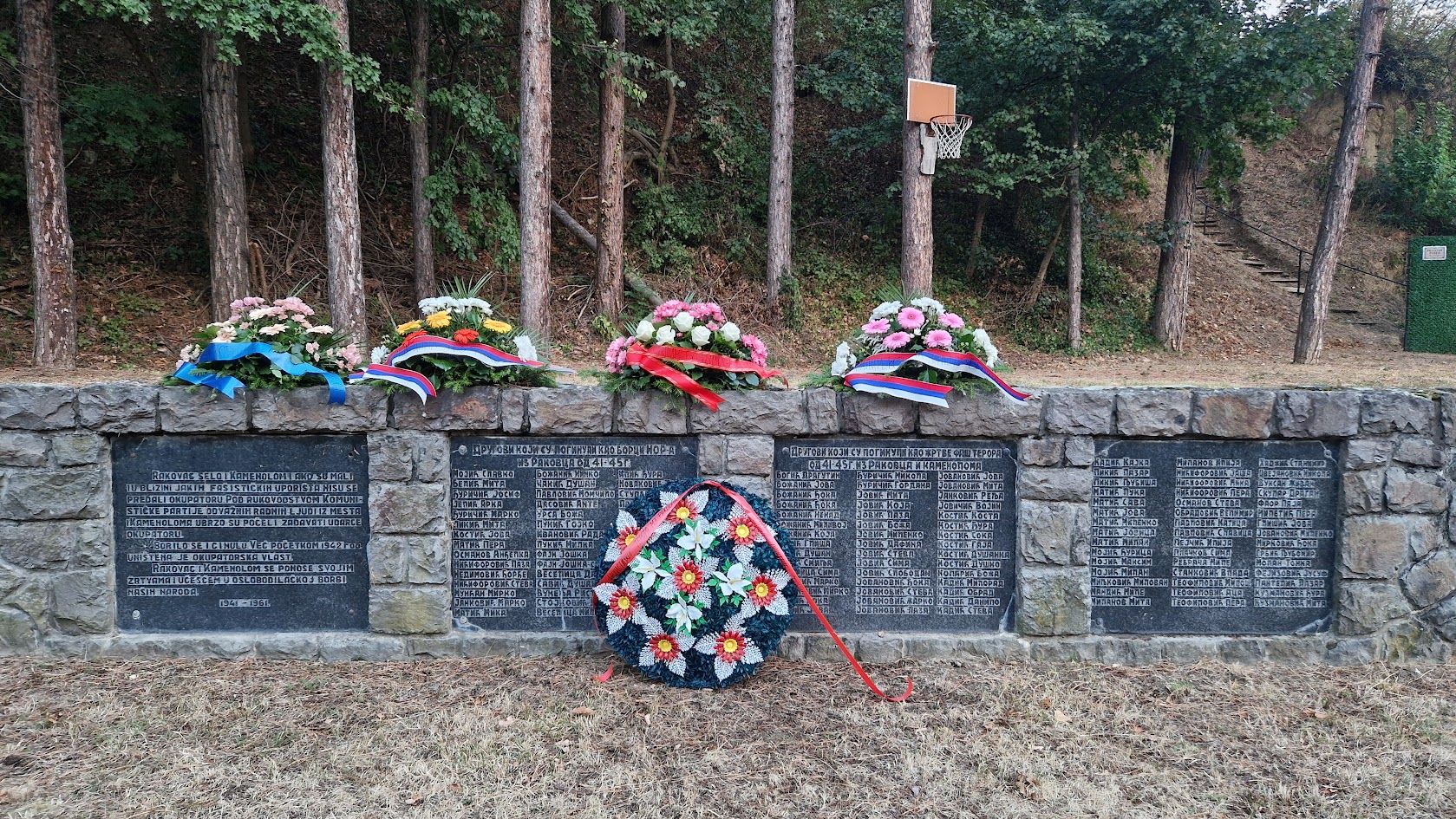
Spomen-obeležje Kamenolom
The memorial near the monastery where villagers and quarry workers took the partisan oath in 1941, with the names of the fallen and of the civilian victims.